

It’s Valentine’s Day 2019. I’m working in Tower Bridge, and as I get ready to leave, I am already picturing the walk along the South Bank. London doing its best impression of the opening scene of a film. But my CEO asks for a quiet thirty minutes.
He gets to the point quickly, “Don’t come in tomorrow.”
Then he pauses, looks at me, and says, “I’m surprised you’re not crying.”
I walk out without even bothering to clear my desk.
I’d spent four years in situations I knew were wrong. The adventure I’d signed up for had been over for most of them. But I’d been stuck. I am an engineer at heart, and my competence was demonstrable. Becoming a CTO meant relying on others and scaling by creating systems that enabled them. It worked, but left me terrified I’d discover I had nothing to offer outside that one business.
This feeling had grown since the first time we sold, a year earlier. It was a trade sale, one business buying another. My mentor pulled me aside with the expression of someone delivering news they’d rather not.
“Prepare to be sacked,” he said.
He explained that the new owners wouldn’t understand the business’s opportunities, the details of how we operated, or, frankly, what I actually did. How they’d have their own plan and I wouldn’t be part of it.
A few months in, his predictions proved accurate. Their top-down approach was clashing with the autonomy we’d built. I was summoned and found myself at one end of a ridiculously long boardroom table. The new owner was furious, but it seemed somehow childlike in his ill-fitting suit. His HR director was at his right hand, watching it all with a thin smile.
He opened by telling me the outcome of the meeting would be that I’d go and sack someone who’d offended him over hiring a barista. Then he yelled at me for three hours.
I said nothing. Weathered the storm. Waited for my own end to come.
Instead, I was offered a deal to stay for the next few years. I was shocked, confused, and knew I should leave. My reluctance resulted in a meeting with the same HR director. I tried to explain my issues with the culture, and she looked up and said, brightly, “Do you know what they say when you assume?”
I had a sharp, vulgar, and funny response ready. I said nothing and just signed instead.
My friend had built a countdown clock. Three years, measured to the second.
Just as time was about to run out, we sold again. Delisted by PE and acquired by an American company I’d never heard of. My mentor’s prediction rang in my ears as most of the exec team went immediately. I waited patiently for my turn.
Again, it didn’t come. They asked me to stay and offered me the chance to invest. I knew I shouldn’t take it. I’d just lived through three years of being in the wrong situation. But I signed, because underneath the calculation was a simpler fear: that if I walked away, I’d find out there was nothing better waiting.
The cultural fit became apparent quickly. In a loft office they’d rented whilst acquiring us, I watched the new CEO work through one of my colleagues. Dismantling him in front of the team and calling it “feedback in the moment.”
I found other ways to work through my feelings.
We arrived at Charlotte Douglas Airport for a visit to their headquarters, and I was at the car rental desk. The woman behind the counter had a short, company-mandated list of available options. I leant into my Britishness, lost even more of my Northern accent, and, with my embarrassing levels of charm, managed to avoid the nondescript, generic family rental. I drove away in a bright yellow American muscle car.
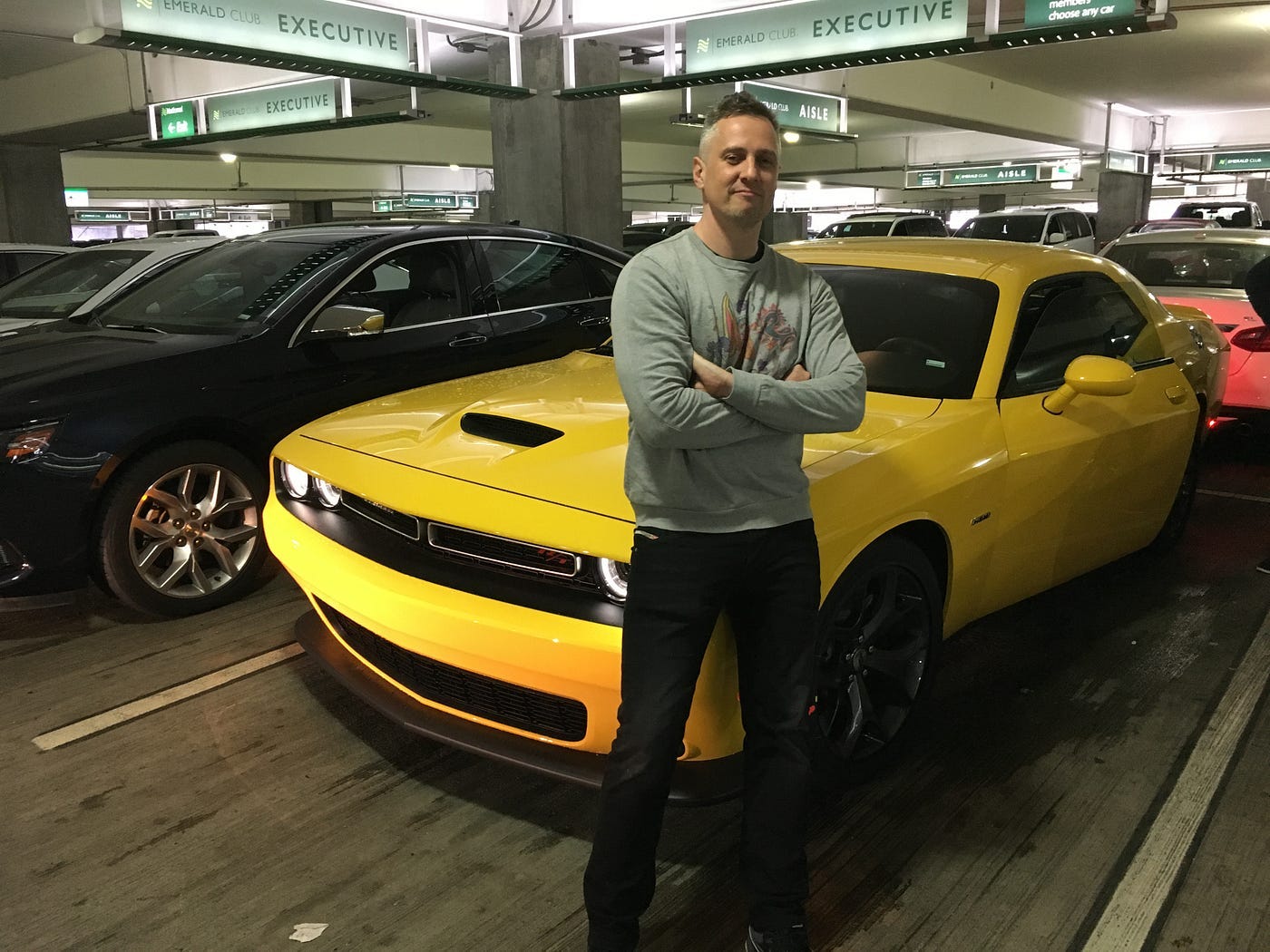
My colleagues rolled their eyes when I explained what I’d done with a stupid grin on my face.
We drove straight to their offices. As I turned into the car park, I dropped a gear, hit the accelerator, felt the back end step out, and drifted into the parking space.
Two security guards came sprinting out of the building.
I sat there with the engine ticking, watching them jog towards me. My colleagues had their heads in their hands.
On that Valentine’s Day, as I walked out of that building, I called my closest friends. We ended up at the bar at the top of the Shard. Sipping ridiculously expensive champagne, I stared through my faint reflection out across London and waited to feel worse than I did. I sensed it was more than the fact that they’d forgotten to block my company credit card.
The months that followed were strange. My mentor put me in touch with his lawyer, and negotiations began. I started looking for a job properly for the first time in over a decade, which was its own kind of disorienting. For nearly ten years, I’d been the CTO of the same company. I’d been involved in almost every system. Everyone knew me, and I knew everyone. Walking into rooms as just myself, without any of that behind me, felt genuinely odd.
My first interview started well, or so I thought. As I left, an ex-colleague caught me in the corridor. We’d had to let him go from a previous company for financial irregularities. He was smiling as he said it.
“Don’t worry, Mike. I told them you didn’t really do anything. It was your friends who did everything.”
My biggest fear, said out loud, with a smile, in my first interview.
Maybe I was right all along.
The months that followed contained humbling and difficult moments in equal measure. Recruiters not returning calls. Interviews that went nowhere. Processes that were beyond awkward.
It was the kind of hopeless that rewatching all of Game of Thrones in preparation for the final season couldn’t fix.
Then a friend, who’d had the self-awareness to leave years earlier, referred me to a headhunter. That quickly turned into an interview on a sunny spring day. The founder and I were laughing so much that the HR director had to come in. We’d gone way over. One of those people you hit it off with immediately.
Scaling by stepping back had forced me to see the business whole: not just the technology, but how everything connected. And the people I’d enabled were experts in their own right. I’d learned as much from them as they had from me. Walking into that room, it turned out to be exactly what the founder was looking for. As my friend George likes to say: “game recognise game”.
I walked out and realised I was suspiciously excited.
I felt hope again as I worked my way through London’s tube system to Camden.
Because I’d just vanished one day, my friends had arranged the leaving drinks I never got to have. They’d chosen the bar where we’d all worked together when we first bought the company, nearly a decade earlier.
I got there early. Sat outside with a few of the very old friends who’d arrived first, talking about all the memories from this place.
The founder brought me here after my interview, over a decade ago. He’d just come back from Vegas, where his friend had won the World Rock Paper Scissors Championship (yes, really). He’d done well himself and walked me through the psychology behind it.
He then challenged me to a game. If I won, I would get the job. A quick learner, I kept calling him Scissor Man as he reached for paper.
He gave me the job but made sure I never won anything again.
There were speeches. Drunken ones, mostly. Gifts, too, including a t-shirt from a YouTuber I’d tormented them with over the years. I was dragged up. I remember saying off the cuff that I was glad the journey, not the destination, mattered, because the destination hadn’t been that great.
But I realise now I was only half right.
As my friend got off the table after another impromptu toast, I looked around the room. People I hadn’t seen in months. People who covered the full ten years. A few I hadn’t expected at all. People who’d given me opportunities, helped me get better, backed me when I got things wrong, stayed when things got hard. And one who’d quietly got me back in the room when I needed it most.
Yet again, my friends had done everything.
If I wasn’t so Northern, that’s the moment I would have cried.