


In the late 1700s, Prussian foresters decided to optimise their forests with science. They cleared the undergrowth, stripped out the diversity, and planted neat and efficient rows of Norway spruce. For one generation, it worked brilliantly, then the forests died and turned to desert. The mess they’d stripped out was the ecosystem that made it work.
I rediscovered that story while writing this post, not by memory, but asking my AI to compare the draft against my personal notes. It surfaced highlights from James C. Scott’s Seeing Like a State, a book I read about fifteen years ago. The concept at the heart of it, metis, the practical knowledge that comes from experience, turned out to be the perfect frame for what I’ve been worried about.
For the past year, as I integrated AI into my workflow, I worried I was ignoring history, removing what seems messy but is essential. Even when the AI suggested a fifteen-year-old book at the right moment, I was unsure if the system was working as intended or if it’s AI trolling me.
Here’s where I’ve got to.
The undergrowth
A year ago, I wrote about my iPad note-taking system. I write all my notes by hand for every meeting on an iPad with an Apple Pencil, using rapid logging. Writing by hand forces me to listen. You can’t transcribe fast enough to capture everything; you need to decide what matters. It’s self-imposed friction I’m happy to keep because it helps me integrate more information.
The problem is that I’m terrible at the admin that this creates. Processing notes, routing tasks, preparing for meetings, and maintaining a knowledge base. I know that skipping it will let things fall through the gaps. But the ever-rising stack of books I haven’t read calls to me yet, and my need to prove that I can beat my son at Mario Kart creates constant tension.
The lazy engineer in me automates the boring bits. But there is a distinction between the parts of my workflow I need and those that need to get done reliably.
The neuroscientist David Eagleman has a name for this split. He calls the busy work vicious friction: taxes, copy-pasting between spreadsheets. The thinking he calls virtuous friction, where the struggle itself is where learning happens.
Outsourcing vicious friction frees capacity, but outsourcing virtuous friction means losing the struggle that makes you better. Eagleman frame the virtuous part as thinking, but for me, it’s any messy work that makes ideas stick.
The system I am building tries to be intentional about categorising this activity.
Meta me
The result is something my friend Jon described as “meta me”. It’s three layers I’ve adapted my process around: what I know, how I act, and where I am.
What I know
The first layer uses nearly ten years of reading, thinking, and connecting ideas, externalised into an Obsidian vault.
Each note captures a single concept that is tagged by type and maturity, is linked to related ideas, and is grouped under Maps of Content. Organisational design, strategy, communication, psychology, and knowledge management.
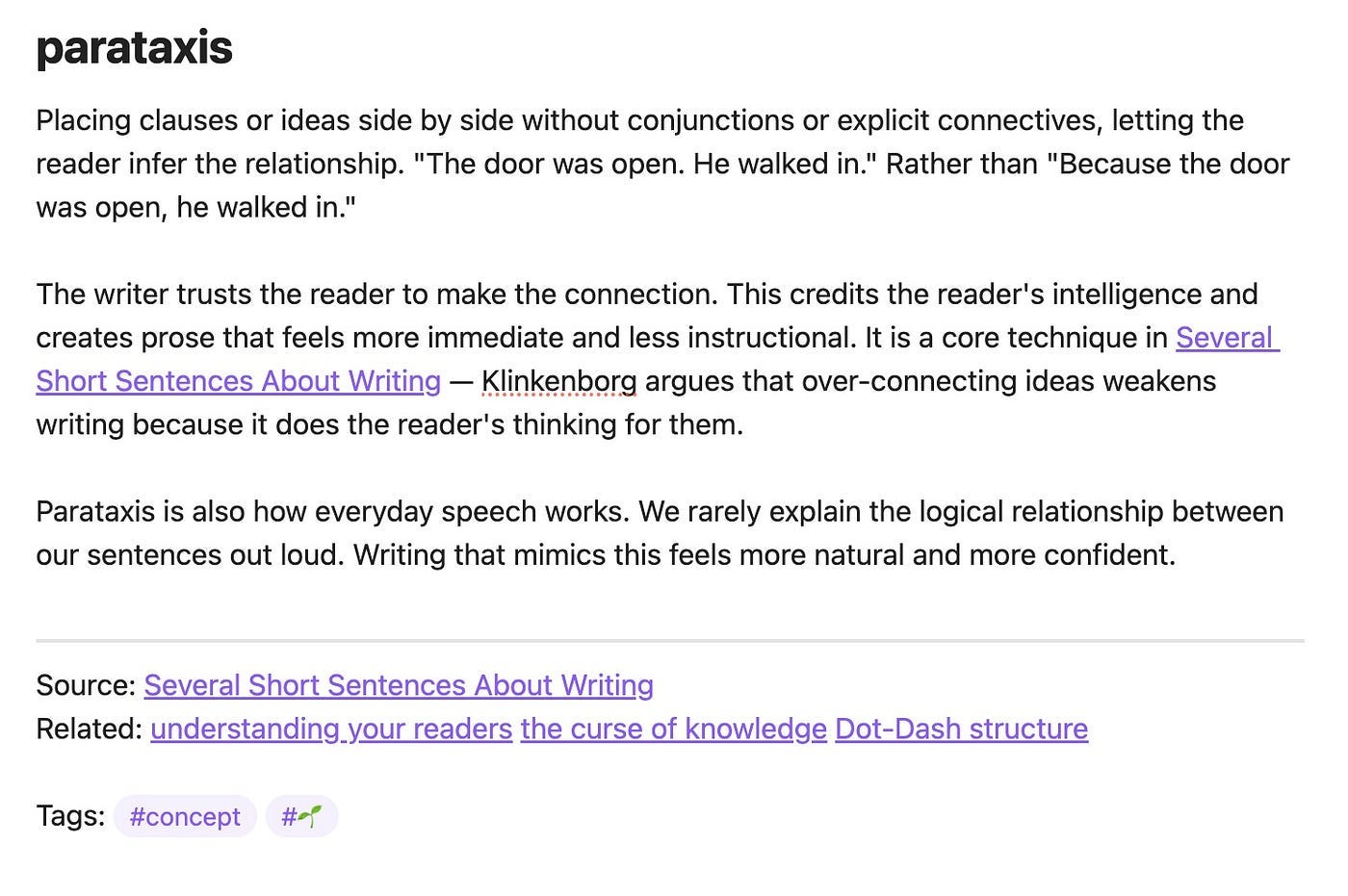
An example note from my Obsidian vault
It represents my personal perspective on what matters, built from years of reading, podcasts, and mentoring. It is the underpinnings of the mental model I have built of the world.
Using this approach to note-taking means I have a structured system that provides a version of my taste for AI to draw on, as I would.
How I act
The second layer encodes how I work. Or how I want to work. AI tools have a feature called skills: a set of instructions, reference files, and decision logic that the AI loads and runs.
They are powerful and easy to offload work to.
What I have found useful is being clear about the process I want them to run. I’m opinionated about my approach; I know what the output should look like, and I’m offloading the processing.
The first example is pure vicious friction. I have a skill that processes my handwritten notes. It reads my handwriting, parses the rapid logging notation, categorises each item, and writes a journal entry into my vault. Tasks become checkboxes I can query. Notes become searchable text. Items get routed to the right 1–1 folder. A page of handwriting becomes data I can build on. AI removes the vicious friction that the virtuous friction creates.
The second example sits at the border of virtuous and vicious. When I’m writing a strategy document, the thinking is mine. What matters, how I frame it, where I’d push back. The skill knows what good looks like from the years I’ve spent reading about strategy and tackling complex problems. It assembles a draft from my notes, what I’ve learned, and transcripts from relevant conversations. I engage with the thinking. It does the processing.
Both work because I’m offloading the processing, not the judgment.
Where I am
The third layer is the state that represents my own KPIs.
This is partly inspired by the beautiful handwritten trackers I’ve seen. I always fancied creating one, but I get zero value from the work itself. Managing the tracker becomes its own task, and the moment it slips, the data goes with it.
I aggregate as much as I can: my Oura stats, my body composition from Withings, my publishing stats across Substack and Medium. My training load from Strava. My goals for the year and how I’m tracking against them.
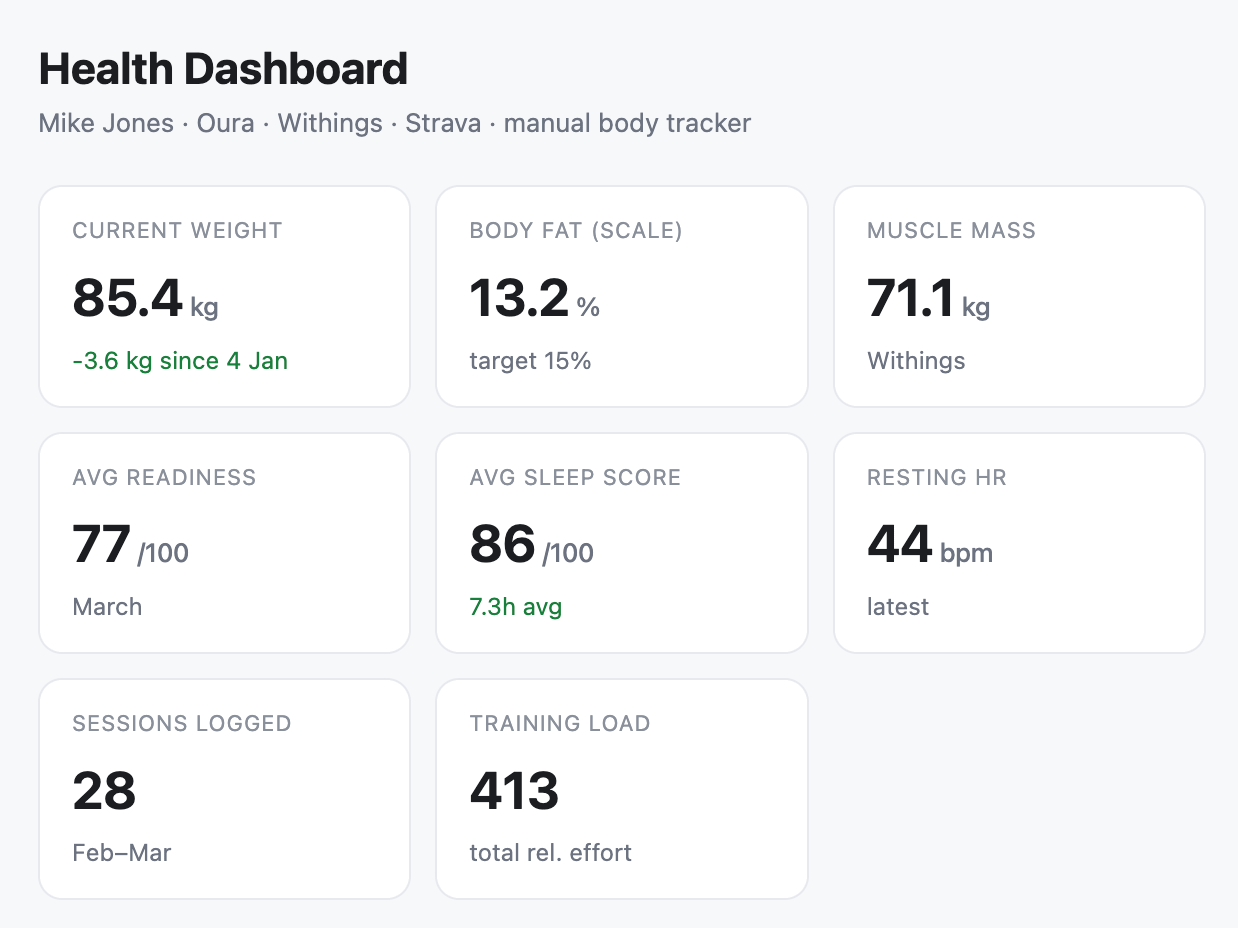
But the state isn’t just the stats from digital devices. I process my journal to capture how I feel: whether I’m energised or grinding, where my focus is, what’s bothering me, where my attention sits, and what I am aware of.
This layer matters because it tells me whether what I’m doing is making a difference. The combination of knowledge, action, and state helps me answer the question, “Is what I’m doing working?”
The cycle
The system is not static. The three layers are what I can do today, but I also want to use them to improve myself and what I am capable of producing.
I was lucky enough to speak to Peter Steinberger for an hour about AI recently. When he described how he uses AI, he was at pains to make sure I understood that you use AI to train you how to use AI.
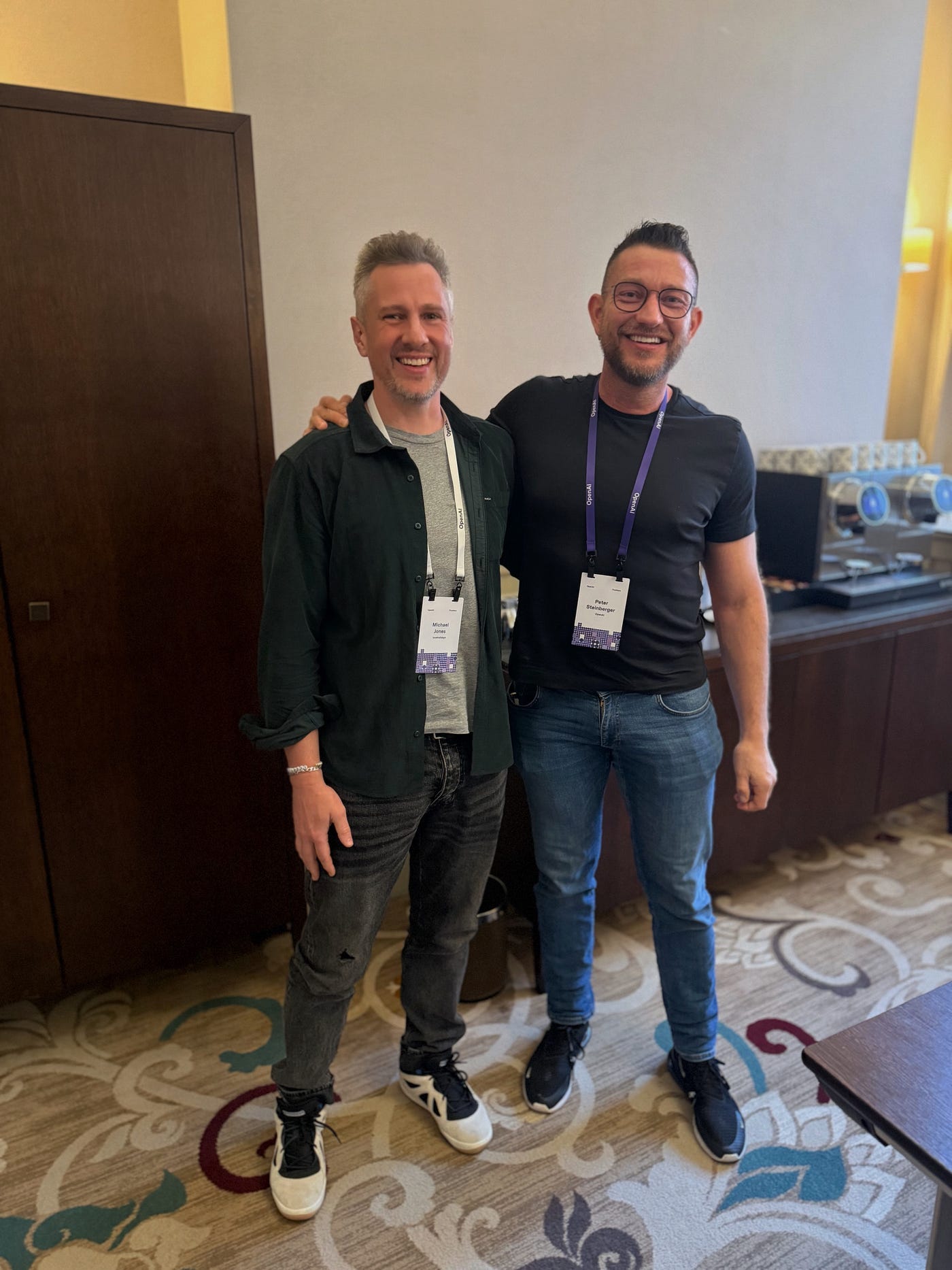
It’s an elegant insight that’s only obvious in hindsight (“let me Google that for you”). Learning to adapt yourself to get the best out of the technology is a fascinating approach.
We have different goals. Peter goes deep into one domain. I like connecting ideas across many. But the basic loop is the same. Getting better means iterating on yourself. John Boyd called the loop OODA: observe, orient, decide, act. Agents call their version ReAct: reason, act, observe, reason again. People and agents iterate the same way.
What AI changes for people is the speed of iteration, not the necessity of human involvement. No matter how efficient AI becomes, the important, messy learning remains with me. That is intentional and crucial to growth.
The three layers I have built support these loops. To learn something new, I read to expand my knowledge, add notes to my vault, encode the learnings into skills, and apply those skills to my own output. This tells me where I am and whether what I’m doing is actually working.
Each loop’s output becomes input to the next iteration, with more context. The system compounds. It’s both the foundation of what I know and a way of shaping the person I want to become. This is quite abstract so worth an example.
Learning to write
I envy people who can write well. People who take their complex thoughts and make them simple and engaging enough to wade through.
I wanted to use my new AI-enabled loop to see how far it could help me.
I started by reading several books on writing. Each is looking at it from a different perspective: how to tell a story, what online writing looks like, and how to construct sentences along with grammatical nuances. Insights I wanted not only to understand and remember but to change how I write.
To this end, I now have a skill to discuss the books as I read them, helping me work through the learnings and craft atomic notes as I go.
Then I take those notes and create a skill that embeds the specific elements I found compelling and want to integrate. I use this new skill to give me feedback on my writing.
My last blog post was an attempt to implement more of the story-style writing Matthew Dicks would suggest. It was a break from the norm. It was fascinating, received great feedback, and was accepted for publication on Medium.
One type of feedback is using the skill on one post. The state layer adds another. I’ve used the same skills to review everything I’ve written, seeing through the author’s lens what worked and where I went wrong. I grade my work and couple that with the post’s performance on the platform where I publish it.
Extracting my writing data into one place lets me get meta information about my writing. As part of this process, the AI helpfully characterised my work into four segments based on these two dimensions (Crowd Pleaser, Hidden Gem, Star, and Improve).
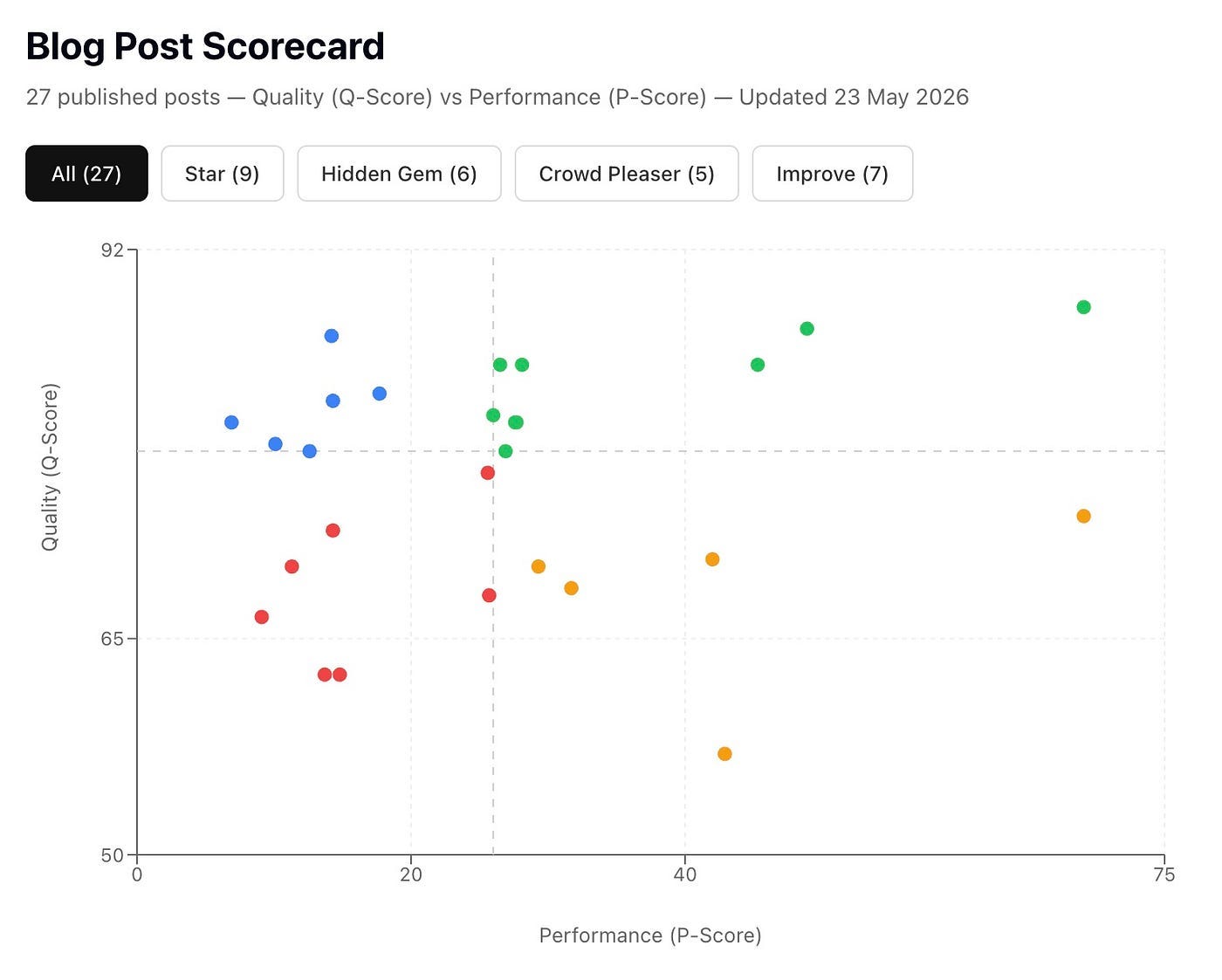
My most-read post by a factor of ten is the iPad note-taking piece (which this post is the sequel to), and it also has my lowest craft score. One takeaway is that people want something useful, whereas I am writing for myself, and I need to further adapt how I frame my ideas if I want to get any traction.
Seeing the forest
The Prussian foresters stripped the undergrowth, and the forest’s ecosystem collapsed. My ecosystem, with this approach, has become much bigger. Handwriting and listening continue to be important. But it’s expanded to include the reading, the encoding, and the feedback from the loop itself.
Things AI could plausibly take, but are the foundations on which everything else rests.
The encoding is where the practical knowledge, or metis, starts. You can’t turn ideas from a book into a working skill without understanding them. Half-grasped concepts don’t give you great feedback. Judging how AI responds to my ideas gives another new way to learn. It’s all validating that what you have learned has stuck.
What AI does for me is buy back the time I’d otherwise spend on vicious friction. I use that time to run more loops, faster, in parallel. Writing is one. I’m also designing workouts, optimising my diet, writing strategy, processing my journal, and even pursuing Jungian individuation.
I’m starting to feel productive in many different domains.
The process has helped me figure out a scene in Star Trek IV that I found confusing in its coherence as a kid (bear with me on this one). The crew had travelled back to 1986, and in one scene, Scotty picks up the mouse and tries to talk into it. Confused, they hand him the keyboard, and he types fast. It now makes sense that he can, even with all the technology of his future, because he needed the virtuous friction to develop metis. There wasn’t a shortcut.
I heard about the idea of “feeling the AGI” the other day. The moment you first get into a Waymo and realise that there is no one driving. I have had a similar experience with how I am approaching learning now. But not in terms of “oh, this is going to replace me”. More “oh wow, I am going to learn a lot from this”.
Metis always has to be built. The tools just compress how long it takes.
If you want to start
The system above took a year of fits and starts. If you want to begin, the smallest working version is this:
Get Obsidian. Set up a vault.
Talk to your favourite AI about how to use it. Have it propose a structure that fits how you think.
Create a skill that takes notes from a book you’re reading. Iterate on it until it captures what matters to you.
From that skill, extract another one for the next thing you want to do better. Iterate.
Repeat.
You don’t need ten years of vault or three layers from day one. You need one loop running. The rest grows from there.