

Wednesday afternoon. 4pm. Third flat white and I’m still fading.
The burrito was probably a mistake. The huge cookie definitely was. But here we are again.
In three hours, I’m supposed to be at BJJ. I can already see myself in the car park, engine running, having the same tired negotiation: “Do I really need to get my ass kicked by young lads for an hour and a half?”
I work out religiously. But I’ve used that as an excuse to eat whatever I want. “Abs are made in the kitchen” has always bugged me, and I’ve dabbled. Sober October. Blood tests.
All ways of avoiding the actual work of fixing my diet.
Two Scientists and a Podcaster
I’ve always been a sucker for the next health thing. I’ve done Zoe twice. I’ve been to “a vegan wellness retreat run by a rugby player who once killed a chicken with his bare hands”. (Yeah, that’s me in a hot tub in a national newspaper.)
Keto was one of these. I’d tried it twice before, cutting carbs low enough that your body switches from burning glucose to burning fat. Both times, I sabotaged it. Discovering white wine is low-carb turned the diet into an excuse to drink in the evening. Another time, my cravings led me to spend a Saturday buying ingredients and baking keto cupcakes. One bite and I spiralled straight back to carbs.
Then two episodes of Steven Bartlett’s Diary of a CEO kept landing in my YouTube feed. One with Dr Annette Bosworth, another with Dr Benjamin Bikman, both talking about insulin resistance and what it does to your body. They were describing exactly what I was experiencing: everything I’d been writing off as just getting older.
It felt like that parable of the drowning man who waves off two boats and a helicopter because he’s waiting for God. I didn’t want to be that guy.
I’d started to feel the benefits of keto before, but I’d never sustained it long enough for them to stick. That would take something more drastic.
No Escape Routes
It’s New Year’s Eve, and I’m watching ridiculously large fireworks over the harbour from my balcony, still basking in post-Christmas indulgence. I decided to give it another go. This time, I’d treat it like a work problem. Build a system. Measure inputs. Track outputs.

But more than that, I’d give myself no escape routes. Keto alone hadn’t worked because I’d found workarounds every time. So I added intermittent fasting because I can’t be trusted around a pain au chocolat, and cut alcohol to remove the evening temptation. I threw in daily journaling on a whim. That turned out to matter more than any of it.
I didn’t announce anything. Just started measuring on January 1st. (Then proceeded to mention it 30 seconds into any conversation to absolutely anyone.)
That first day, I skipped breakfast, ate a load of eggs for lunch, then had a steak with some creamed spinach.
41 days to go.
You Gotta Have a System
I struggle with restriction at the best of times. Tell me I can’t have something and I’ll find a way to get it. I’d proven that twice already. Honestly, Rage Against the Machine have a lot to answer for in my life.
So I had to stop relying on willpower and build a system that worked with how I actually behave.
I tracked weight, body fat, glucose, and ketone levels, as well as vital statistics. Had keto bars instead of fighting cravings. Black Americanos instead of flat whites to save the carbs for later. Replacements rather than abstinence, because one pizza and you’re out of ketosis.
The data unexpectedly kept me going. You lose a lot of water early with keto, so you see the impact immediately. When the numbers confirm it’s working, it reinforces behaviour. I used AI as a coach, too. Photographing restaurant menus, brainstorming meals from whatever was in the fridge. It took the thinking out of eating, which is what always beat me before.
The journalling I’d thrown in on a whim became part of the system, too. Not as a wellness exercise. As a way of noticing what was actually going on. The diet addressed my body, the data fed my rational brain, and the journaling surfaced what was underneath.
Less Puffy
I’m writing this six weeks in. The results: 8kg lighter, 5% body fat down to 11.6%. It’s the best I’ve felt in over a decade. Other people have noticed too, although “your face is less puffy” is a compliment I’m still figuring out how to take.
But the numbers only tell part of it.
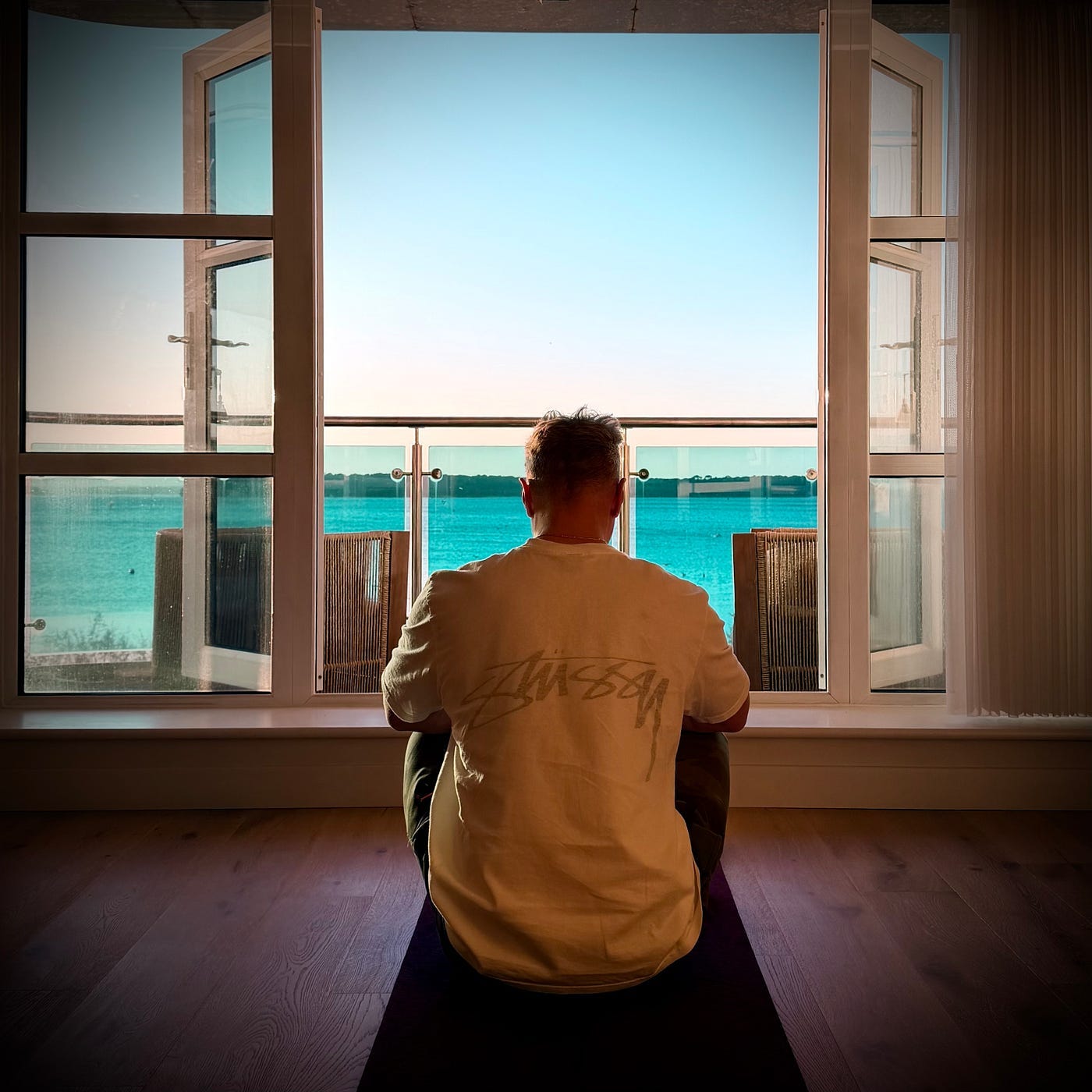
Same balcony where I made the decision six weeks earlier.
I have focus and energy I’d forgotten was possible. One weekend, I drove to the beach, wrote two blog posts, ran, swam, did weights, and did yoga. Recovery was easier because I finally had sleep that actually felt like sleep.
I used AI to review my journal. It said, “Journaling didn’t change your life. It helped you notice that your life was changing.” I liked that.
One of the weird things that changed, which I put down to dopamine desensitisation, is that I now love the taste of water. Before it had the taste of nothing, a drink to tolerate whilst waiting for coffee. Now it tastes clean. I promise I’ve not joined a cult. It’s one of those small markers that something fundamental shifted.
Wednesday at 4pm looks different. No slump. But I’m still negotiating in the car park… turns out I still don’t want to get my ass kicked, but that’s just an ego problem now. Will journal about that later.
Way Too Many Eggs
Six weeks of this intensity can’t go on forever, though.
Obsessive tracking takes time and mental energy. And I was SO sick of what I was eating. At some point, I stopped looking forward to food. Eating was more of a chore than an enjoyable experience. I also just wanted a bit of fruit, a bowl of pasta, not more meat and cheese.
The food wasn’t the toughest bit.
Without alcohol, I had to sit with feelings I’d been quietly numbing. Evenings felt longer. Social situations had an edge I hadn’t noticed before. The journaling made this impossible to ignore. Writing down how you feel every day makes the patterns obvious. I could see how often I’d been reaching for a drink, not because I wanted one, but because I didn’t want to feel something.
A friend once told me, “Drinking and food aren’t the problem, they’re the solution.” I didn’t understand that properly until I saw it in my own journal, week after week.
Leaning into it was harder than any amount of eggs. But it was satisfying too, in a way I didn’t expect.
The real cost of these six weeks isn’t the food boredom or the social backlog. It’s that I can’t pretend anymore. I know what the old habits were actually doing. I know what living without them feels like. I can’t unknow that.
I’m anxious about losing this feeling. But I also want to enjoy food and a drink again.
Habits Compound Both Ways
My CEO keeps telling me, “Things just start going wrong after 40.” I’m not convinced. Maybe that’s what happens when small bad habits compound, and we decide it’s inevitable.
The six-week version was the experiment, not the destination.
So I’m tapering off the measurement but keeping the journaling. Reintroducing things one at a time and paying attention to what happens. Being intentional rather than just drifting back to old patterns. The system changes, but the mindset doesn’t.
If you’ve found a way to keep the gains without the intensity, I’d genuinely love to hear how you did it. I’m still figuring that part out.
But first, I’m going to order a pizza and have a beer.